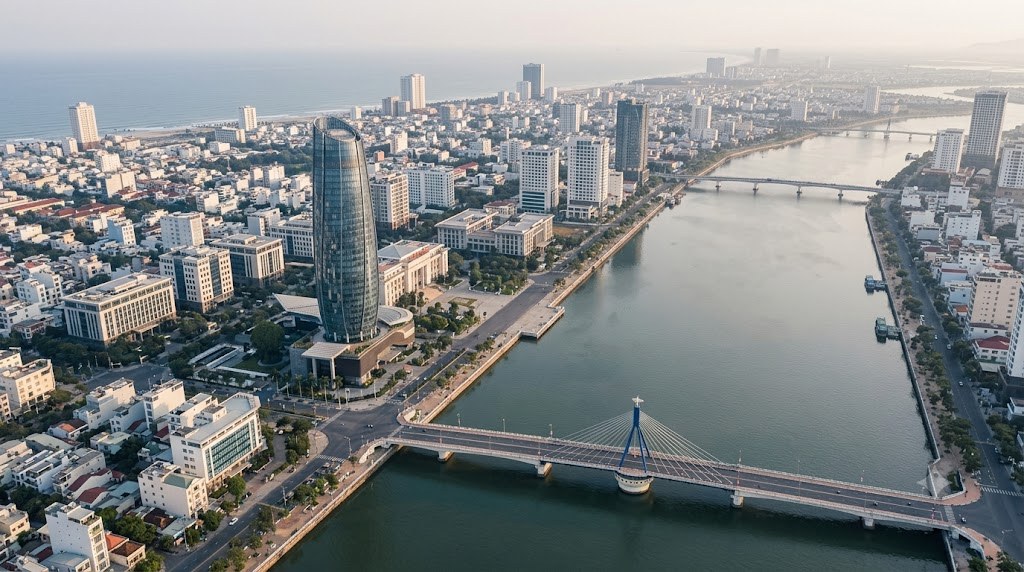
The Đà Nẵng–Quảng Nam Merger: What Changes for Investors
In 2025 Đà Nẵng and Quảng Nam became a single administrative unit, consolidating the licensing authority and reshaping the practical path for anyone investing in central Vietnam.

In 2025, Đà Nẵng and Quảng Nam were merged into a single administrative unit. For residents this was mostly a change of address and signage. For investors it carries more weight, because the two provinces previously ran separate licensing machinery, and an investment project often sits across a boundary — where a factory is built, where a port operates, and where an office is registered. Understanding what actually changed helps you plan with less friction.
It is worth saying at the outset what did not change. The national legal framework is the same across Vietnam. The Law on Investment 2020 and the Law on Enterprises 2020 still govern how a foreign-invested enterprise is formed, and the sequence is unchanged: generally, first an Investment Registration Certificate (IRC) from the provincial investment authority, then an Enterprise Registration Certificate (ERC). Charter capital must still be contributed within 90 days of ERC issuance, and foreign direct investment capital still flows through a Direct Investment Capital Account (DICA) at a licensed bank. The merger changes who you deal with and where, not the underlying rules.
A single licensing authority
The most practical change is consolidation. Where an investor once had to work out which province held jurisdiction, there is now one provincial authority for the combined territory. This matters in several ordinary situations.
- A project that straddles the former provincial line no longer raises a question of which office is competent.
- Where a foreign purchase of capital contribution or shares must be registered — typically when it raises foreign ownership or involves a conditional sector — that registration is filed with the provincial Department of Finance, the authority that absorbed the former Department of Planning and Investment. There is now a single such office for the region, using current forms such as Form A.I.7 and procedures updated by recent circulars.
- Records, prior approvals and site data that were split between two administrations are being brought under one roof, which over time should reduce duplicated requests.
During any merger there is a transition period. Some files are re-numbered, some counters relocate, and staff are reassigned. If you hold an IRC, ERC or land document issued by a former provincial office, it generally remains valid; you do not need to re-apply simply because the letterhead changed. When in doubt about which desk now handles a matter, confirm in writing rather than assuming continuity.
The Free Trade Zone and high-tech incentives
The merger also brings the region's investment-promotion story into a single picture. Two elements stand out.
The first is the Free Trade Zone associated with Liên Chiểu Port. A free trade zone is a defined area with customs and logistics treatment intended to make trade, warehousing and processing more efficient. If your model depends on import, export or re-export flows, it is worth checking whether locating inside the zone changes your customs position and your cost base.
The second is the region's high-tech and semiconductor incentives. Vietnam offers preferential corporate income tax and land-lease exemptions for qualifying high-tech projects, and central Vietnam has positioned itself to attract them. These incentives are conditional: they attach to the sector, the location and the commitments in your registered project, not to the company in general. Read the eligibility criteria carefully before you build them into a financial model.
How to read the new landscape
For a foreign investor, the merger does not reopen the question of what you may do. Market access is still governed by Vietnam's WTO commitments and the market-access negative list under Decree 31/2021 — most ordinary sectors permit 100% foreign ownership, while conditional sectors may require a joint venture, an ownership cap or additional licences. What the merger changes is the practical path.
- Confirm your sector's status on the negative list before committing to a site.
- Identify the single competent authority now, and get the current contact and form set in writing.
- If incentives drive your case, verify eligibility against your registered project, not the brochure.
- Keep dispute resolution in mind at the drafting stage — a VIAC arbitration clause must be written into the contract in advance.
On balance, the consolidated administration is a simplification. Treat the transition period with patience, verify rather than assume, and the new structure should make central Vietnam easier to enter, not harder.
This article is general information as of 2026 and is not a substitute for licensed legal advice. Laws and administrative procedures change, and specific projects should be assessed on their own facts.
告诉我们你正在权衡的决策,我们会帮你看清它。
预约初次洽谈